L'axe « Innovations scientifiques et responsabilité » interroge les rapports entre le progrès technologique et la conscience éthique. Des révolutions médicales aux intelligences artificielles, en passant par les biotechnologies, l’exploration spatiale ou les énergies renouvelables, les découvertes scientifiques transforment nos vies à une vitesse sans précédent. Mais toute innovation soulève des questions cruciales : jusqu’où peut-on aller ? Qui décide de ce qui est acceptable ? Comment concilier la quête de connaissance avec le respect de l’humain et de la planète ? Dans les sociétés anglophones, ces débats sont vifs, entre une culture de l’innovation libérale et des revendications citoyennes pour un encadrement éthique. Cet axe invite les élèves à examiner des études de cas, à comprendre les espoirs et les craintes liés aux nouvelles technologies, et à développer une réflexion nuancée sur la responsabilité des scientifiques, des États et des citoyens.

🔬 Vocabulaire thématique : Innovations scientifiques et responsabilité
Ce vocabulaire est indispensable pour parler des progrès scientifiques, des nouvelles technologies, des enjeux éthiques et des défis environnementaux.
| Anglais | Français |
|---|---|
| scientific breakthrough | percée scientifique |
| research | recherche |
| development | développement |
| innovation | innovation |
| technology | technologie |
| artificial intelligence (AI) | intelligence artificielle (IA) |
| machine learning | apprentissage automatique |
| algorithm | algorithme |
| genetic engineering | génie génétique |
| cloning | clonage |
| stem cells | cellules souches |
| GMO (genetically modified organism) | OGM (organisme génétiquement modifié) |
| bioethics | bioéthique |
| ethics | éthique |
| moral responsibility | responsabilité morale |
| accountability | responsabilité (reddition de comptes) |
| precautionary principle | principe de précaution |
| side effects | effets secondaires |
| risk assessment | évaluation des risques |
| sustainability | durabilité |
| renewable energy | énergie renouvelable |
| fossil fuels | énergies fossiles |
| climate engineering | géo-ingénierie climatique |
| space exploration | exploration spatiale |
| test tube baby | bébé-éprouvette |
| designer baby | bébé sur mesure |
| to trigger a debate | déclencher un débat |
| to ban | interdire |
| to regulate | réglementer |
| to cure a disease | guérir une maladie |
| to play God | se prendre pour Dieu |
🔮 Grammaire – Exprimer le futur, la probabilité et l’hypothèse
Pour parler des innovations et de leurs conséquences, on utilise une variété de structures permettant d’exprimer des degrés de certitude, des prédictions, des hypothèses et des recommandations.
A. Will / Going to : prédictions et projets
| Structure | Utilisation | Exemple |
|---|---|---|
| will + base verbale | Prédiction basée sur une opinion, une décision spontanée ou un fait futur considéré comme certain. |
AI will revolutionise medicine. I think scientists will find a cure soon. |
| be going to + base verbale | Projet déjà prévu ou prédiction fondée sur des indices présents. |
The company is going to launch a new electric car next year. Look at this data – temperatures are going to keep rising. |
B. May / Might / Could : exprimer la probabilité
| Modal | Valeur | Exemple |
|---|---|---|
| may / might | Possibilité (plus ou moins 50 % ou moins). | Gene editing may cure hereditary diseases, but it might also create ethical problems. |
| could | Possibilité théorique ou capacité future. | Space tourism could become affordable in twenty years. |
C. Les conditionnels pour les hypothèses
| Type | Utilisation | Exemple |
|---|---|---|
| Type 1 | Hypothèse réaliste. | If we invest in renewable energy, we will reduce pollution. |
| Type 2 | Hypothèse peu probable ou imaginaire. | If scientists created a perfect AI, would we trust it? |
| Type 3 | Hypothèse sur un passé non réalisé (regret). | If the government had regulated the technology earlier, the scandal would have been avoided. |
D. Structures pour exprimer l’obligation et la recommandation
| Structure | Valeur | Exemple |
|---|---|---|
| should / ought to | Conseil, recommandation morale ou éthique. | Scientists should always consider the long-term effects of their discoveries. |
| must / have to | Obligation forte. | Governments must regulate AI before it is too late. |
| need to | Nécessité. | We need to find sustainable alternatives to plastic. |
Innovations et éthique dans le monde anglophone
Le monde anglophone a été le berceau d’innombrables révolutions scientifiques : la machine à vapeur de James Watt en Écosse, la théorie de l’évolution de Charles Darwin en Angleterre, l’invention du téléphone par Alexander Graham Bell au Canada, l’ampoule électrique de Thomas Edison aux États-Unis, ou plus récemment l’Internet et les premiers smartphones. Cette tradition d’innovation s’accompagne d’un débat permanent sur la responsabilité.
Dès le XIXᵉ siècle, la révolution industrielle britannique a suscité des interrogations sur les conditions de travail et la pollution. Frankenstein (1818) de Mary Shelley, souvent considéré comme le premier roman de science-fiction, met en garde contre un scientifique qui, par orgueil, crée une vie sans en assumer les conséquences. Ce mythe est encore évoqué aujourd’hui lorsqu’on parle de clonage ou d’intelligence artificielle.
Aux États-Unis, la course à l’espace et le projet Manhattan (la bombe atomique) ont illustré la double face du progrès : la fierté nationale d’un côté, la destruction massive de l’autre. Robert Oppenheimer, directeur scientifique du projet Manhattan, déclara après les bombardements d’Hiroshima et de Nagasaki : « Now I am become Death, the destroyer of worlds. » Cette citation résume le vertige du scientifique face à sa création.
La bioéthique est un autre champ central. En 1996, la naissance de la brebis Dolly en Écosse, premier mammifère cloné à partir d’une cellule adulte, a provoqué un séisme médiatique et éthique mondial. Le Royaume-Uni a depuis adopté des lois strictes sur le clonage humain. Aux États-Unis, le débat sur les OGM et les pesticides a été porté par des figures comme Rachel Carson, dont le livre Silent Spring (1962) lança le mouvement écologiste moderne.
Aujourd’hui, l’intelligence artificielle est au cœur des préoccupations. Des entrepreneurs comme Elon Musk ou des chercheurs comme Geoffrey Hinton alertent sur les risques d’une IA non contrôlée, tandis que les gouvernements tentent de légiférer. En 2023, le Royaume-Uni a accueilli le premier sommet mondial sur la sécurité de l’IA, marquant une volonté de concilier innovation et responsabilité.
Ainsi, le monde anglophone oscille entre la célébration du génie scientifique et la conscience aiguë de ses dangers. C’est dans cette tension que se construit une citoyenneté scientifique responsable, où le public doit être informé et consulté.
Dolly, OGM, IA : débats éthiques majeurs dans le monde anglophone
Dolly, le clonage et la brebis écossaise
En 1996, l’Institut Roslin à Édimbourg annonce la naissance de Dolly, le premier mammifère cloné à partir d’une cellule adulte. L’événement est salué comme une prouesse scientifique, mais il déclenche immédiatement une tempête éthique : allons-nous vers le clonage humain ? Le gouvernement britannique réagit rapidement et interdit le clonage reproductif humain. Dolly devient un symbole des promesses et des périls de la génétique. Aujourd’hui, les techniques de clonage sont utilisées en recherche médicale, mais le débat entre science et éthique demeure.
Les OGM et le principe de précaution
Aux États-Unis, les organismes génétiquement modifiés sont largement cultivés et consommés depuis les années 1990. La Food and Drug Administration (FDA) les considère comme sûrs. En revanche, au Royaume-Uni et dans l’Union européenne, le principe de précaution prévaut : les OGM sont strictement réglementés et étiquetés. Ce contraste illustre deux approches du risque : d’un côté, la confiance dans l’innovation et la preuve scientifique ; de l’autre, la prudence face à l’incertitude.
L’intelligence artificielle entre progrès et régulation
Les géants américains de la tech (Google, Microsoft, OpenAI) dominent la course à l’IA. Mais les lanceurs d’alerte se multiplient. En 2023, le « AI Safety Summit » organisé au Royaume-Uni a réuni dirigeants politiques et experts pour discuter des risques existentiels de l’IA. Elon Musk, Steve Wozniak et d’autres ont signé une lettre ouverte demandant une pause dans le développement des IA trop puissantes. Ces débats montrent que les sociétés anglophones, tout en étant à la pointe de l’innovation, cherchent à en maîtriser les implications éthiques et sociales.
Scientific innovation has transformed our daily lives. However, every technological breakthrough raises ethical questions. Governments, scientists and citizens all share responsibility for ensuring that progress benefits humanity while protecting the environment and individual freedoms.
Exercices
Grammaire
Complétez la phrase avec will, may, might ou could :
- With this new vaccine, we __________ eradicate the disease within a decade. (plusieurs réponses possibles selon le degré de certitude : will pour une certitude, may/might/could pour une probabilité)
-
Mettez au conditionnel type 1 : If people (use) more public transport, cities (be) less polluted. → If people use more public transport, cities will be less polluted.
-
Traduisez en utilisant should : « Les chercheurs devraient communiquer leurs résultats de manière transparente. » → Researchers should communicate their results transparently.
Expression écrite
Sujet : You have read the article “The Promise and Peril of CRISPR”. Write a short essay (150-180 words) in which you :
-
Explain how CRISPR can be both a hope and a danger for humanity.
-
Discuss whether limits should be set on scientific research.
-
Give your personal opinion.
Consignes : structurez votre essai (introduction, développement, conclusion), utilisez au moins trois connecteurs logiques et deux expressions du vocabulaire thématique.
Expression orale
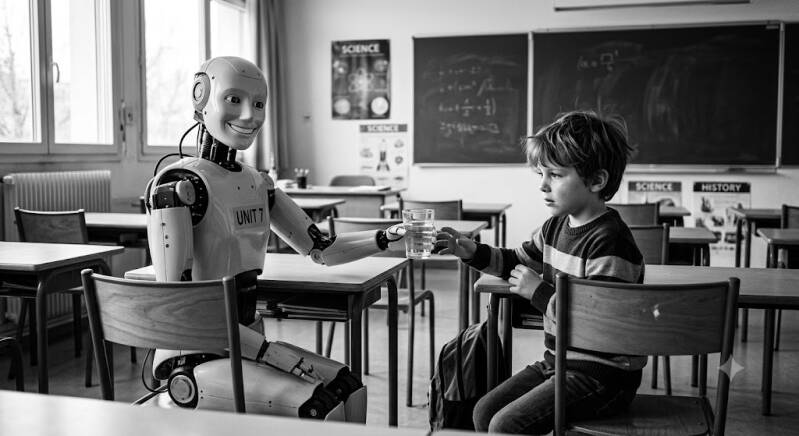
Situation : Vous présentez le document iconographique ci-dessus : une photographie en noir et blanc d’un robot humanoïde assis à une table, face à un enfant. Le robot tend un verre d’eau à l’enfant, qui hésite à le prendre. En arrière-plan, une salle de classe vide. Le robot a un sourire artificiel figé.
Problématique suggérée : Should we trust machines with human tasks?
Points à aborder :
-
Description (personnages, attitude, décor).
-
Signification : la relation humain-machine, la question de la confiance, la délégation des tâches éducatives ou médicales.
-
Lien avec l’axe : innovation, responsabilité, limites éthiques.
-
Opinion personnelle : jusqu’où peut-on confier des tâches humaines aux robots ?
Compréhension écrite
Article (adapté de The New York Times, 2023)
The Promise and Peril of CRISPR: Editing the Human Genome
In 2012, scientists Jennifer Doudna and Emmanuelle Charpentier discovered CRISPR, a tool that allows scientists to edit DNA with incredible precision. The technology raised hopes of curing genetic diseases like cystic fibrosis or sickle cell anaemia. In 2020, the Nobel Prize in Chemistry was awarded to the two researchers.
However, CRISPR also opened a Pandora’s box. In 2018, a Chinese scientist announced he had edited the genes of twin babies to make them resistant to HIV. The scientific community was outraged. Critics argued that gene editing on embryos was dangerous, unnecessary and ethically unacceptable. “We are not ready to play God,” said one bioethicist.
Today, many countries, including the UK and the US, allow gene editing for medical research on adults and embryos under strict regulations, but they ban its use for creating “designer babies”. Yet, the temptation to enhance human traits – intelligence, height, eye colour – remains. “The question is not if we can edit our children’s genes, but if we should,” said Doudna in a recent interview. “Science is moving faster than our moral reflection.”
Questions :
-
What is CRISPR, and what hopes did it raise?
-
Why was the Chinese scientist’s experiment controversial?
-
What does “to play God” mean in this context?
-
What distinction do UK and US laws make regarding gene editing?
-
Explain Doudna’s quote: “Science is moving faster than our moral reflection.”
Compréhension orale
Reportage radio
Voix : This is BBC Radio 4. Today we visit a vertical farm in Liverpool. Inside a former warehouse, lettuce, tomatoes and strawberries are grown under pink LED lights, without soil and with 95% less water than traditional farming. The manager, Claire, explains the concept.
Claire : “It’s called hydroponics. Plants grow in nutrient-rich water instead of soil. We control the temperature, the light, the humidity – everything. It’s like a laboratory for vegetables.”
Journaliste : Is this the future of farming?
Claire : “It has to be. With climate change and population growth, we can’t rely on traditional agriculture alone. Vertical farming uses less land, less water, no pesticides, and you can harvest all year round. It could be a game changer for food security, especially in urban areas.”
Journaliste : But critics say it’s unnatural and consumes a lot of electricity.
Claire : “That’s true, but we use renewable energy. And let’s be honest: what’s ‘natural’ about spraying chemicals on fields? Every innovation is unnatural at first. The question is: does it do more good than harm?”
Questions :
-
What is a vertical farm, and how does it work?
-
Give two advantages of vertical farming mentioned by Claire.
-
What criticism does the journalist bring up?
-
How does Claire respond to the criticism?
-
What, according to Claire, is the key question to evaluate an innovation?
Contrôle continu
A. Compréhension écrite (10 points)
Lisez le texte suivant (adapté d’un article sur l’énergie nucléaire au Royaume-Uni) :
“Nuclear power has always divided opinion. Supporters argue it is a clean, reliable source of energy that can help the UK meet its climate targets. Unlike wind or solar, nuclear plants run 24/7 and produce no carbon emissions. However, critics point to the risks: the catastrophic accidents at Chernobyl and Fukushima, the unsolved problem of radioactive waste and the high cost of building new plants. The UK government recently announced plans to build eight new reactors by 2050. Environmental groups have protested, calling the plan ‘a dangerous gamble’. They argue that investing in renewable energy would be safer and cheaper in the long run.”
Questions :
-
Give one advantage and one disadvantage of nuclear power mentioned in the text. (2 pts)
-
What is the UK government’s plan regarding nuclear energy? (2 pts)
-
Why do environmental groups oppose this plan? (2 pts)
-
True or false? Nuclear plants produce more carbon emissions than wind turbines. Justify with a quotation. (2 pts)
-
Explain the phrase “a dangerous gamble” in your own words. (2 pts)
B. Compréhension orale (10 points)
Script :
“I’m a diabetic, and for years I had to inject insulin several times a day. It was painful and exhausting. Two years ago, I started using a smart insulin pump. It’s a small device attached to my body that monitors my blood sugar continuously and delivers the right dose automatically. It’s connected to my phone, so I can see my levels anytime. Honestly, it has changed my life. But I sometimes wonder: what if the device fails? What if someone hacks into it? I rely so much on technology that I feel vulnerable. My life is literally in the hands of a machine. It’s a strange feeling.”
Questions :
-
What medical condition does the speaker have? (2 pts)
-
What device does she use, and how does it work? (2 pts)
-
What positive impact has the device had on her life? (2 pts)
-
What fears does she express? (2 pts)
-
Explain the phrase “My life is literally in the hands of a machine.” (2 pts)
C. Expression écrite (10 points)
Traitez au choix l’un des deux sujets (80-100 mots) :
-
Sujet 1 : In your opinion, what is the most important scientific discovery of the last 50 years? Justify.
-
Sujet 2 : Write a short paragraph arguing for or against the use of robots in schools.
D. Expression orale (10 points)
À préparer en 10 minutes, à présenter en 5 minutes.
Vous présentez la citation suivante d’Albert Einstein : “It has become appallingly obvious that our technology has exceeded our humanity.”
Expliquez ce que cette citation signifie pour vous, donnez des exemples actuels et reliez-la à l’axe « Innovations scientifiques et responsabilité ».