L’axe « Fictions et réalités » explore la frontière mouvante entre l’imaginaire et le réel. Les êtres humains ont toujours raconté des histoires pour donner un sens au monde, pour s’évader ou pour critiquer la société. La littérature, le cinéma, les séries et les jeux vidéo créent des univers qui, bien que fictifs, résonnent avec nos peurs, nos espoirs et nos questionnements. Les dystopies nous mettent en garde contre des dérives possibles, la science-fiction anticipe les conséquences du progrès, et les récits réalistes reflètent notre quotidien tout en le transformant. Cet axe invite les élèves à interroger la puissance de la fiction : comment influence-t-elle notre perception du réel ? Peut-elle agir sur la société ? Et que révèle notre besoin d’histoires sur la condition humaine ?
📖 Vocabulaire thématique : Fictions et réalités
Ce vocabulaire est essentiel pour analyser des œuvres de fiction, des films, des séries, des romans, des nouvelles ou tout document qui interroge les liens entre réalité, imaginaire et représentation du monde.
| Anglais | Français |
|---|---|
| fiction | fiction |
| reality | réalité |
| plot | intrigue, scénario |
| character | personnage |
| setting | cadre, décor |
| narrator | narrateur / narratrice |
| point of view | point de vue |
| dystopia | dystopie, contre-utopie |
| utopia | utopie |
| science fiction | science-fiction |
| fantasy | fantastique, fantasy |
| magical realism | réalisme magique |
| suspense | suspense |
| cliffhanger | suspense de fin d’épisode |
| allegory | allégorie |
| symbolism | symbolisme |
| escapism | évasion, fuite du réel |
| to blur the line | brouiller la frontière |
| verisimilitude | vraisemblance |
| suspension of disbelief | suspension volontaire de l’incrédulité |
| alternate reality | réalité alternative |
| virtual world | monde virtuel |
| artificial intelligence | intelligence artificielle |
| deepfake | hypertrucage |
| narrative | récit, narration |
| storytelling | art de raconter des histoires |
| to mirror | refléter |
| to distort | déformer |
| to anticipate | anticiper |
| to warn | avertir |
📚 Grammaire – Les temps du récit
Pour parler de fictions (livres, films, séries), on utilise principalement les temps du passé, même si l’histoire est imaginaire. Ces temps sont appelés « temps du récit ».
| Temps | Utilisation | Exemple |
|---|---|---|
| Prétérit simple | Pour raconter des actions ponctuelles et la succession des événements. | The main character left her village and went to the city. |
| Prétérit continu (was/were + V-ing) |
Pour décrire le décor, l’atmosphère ou une action en cours interrompue par une autre. | It was raining when she knocked on the door. |
| Past perfect (had + participe passé) |
Pour exprimer l’antériorité ou revenir sur un événement antérieur à l’histoire principale. | She had never seen such a strange place before. |
| Présent de narration (présent simple / continu) |
Utilisé pour résumer une histoire, notamment à l’oral, afin de rendre le récit plus vivant. | So, this woman wakes up in a parallel universe and tries to find her way home. |
| Discours rapporté | Pour rapporter les paroles ou les pensées des personnages. | The hero said that he would return. |
La fiction comme miroir et marteau dans le monde anglophone
Dans les cultures anglophones, la fiction occupe une place centrale. De Shakespeare à Margaret Atwood, en passant par Charles Dickens, George Orwell ou Toni Morrison, les écrivains ont utilisé l’imagination pour dénoncer des injustices, rêver de mondes meilleurs ou avertir des dangers à venir.
Le XIXᵉ siècle britannique voit le roman social s’imposer : Oliver Twist de Dickens dépeint la misère des enfants des rues et critique les lois sur les pauvres. Aux États-Unis, La Case de l’oncle Tom de Harriet Beecher Stowe contribue à l’éveil des consciences sur l’horreur de l’esclavage.
Au XXᵉ siècle, les dystopies deviennent un genre majeur. *1984* (1949) de George Orwell imagine une société totalitaire où la surveillance est absolue et où la vérité est manipulée. Le Meilleur des mondes (1932) d’Aldous Huxley anticipe un avenir où le bonheur est imposé chimiquement. Plus récemment, La Servante écarlate (1985) de Margaret Atwood décrit une théocratie où les femmes sont réduites à leur fonction reproductrice. Ces œuvres sont nées de craintes réelles – le stalinisme, le nazisme, la montée des intégrismes – et, en retour, elles ont nourri la réflexion politique et philosophique.
La science-fiction a elle aussi un rôle d’alerte. Fahrenheit 451 de Ray Bradbury décrit une société qui brûle les livres, dénonçant la censure et l’abrutissement par les écrans. La série Black Mirror poursuit cette tradition en explorant les dérives technologiques.
Mais la fiction n’est pas seulement critique. Elle offre aussi des échappatoires, des utopies, des mondes où tout est possible. Le Magicien d’Oz, Harry Potter, Le Seigneur des anneaux transportent les lecteurs dans des univers merveilleux. Pourtant, même ces récits d’évasion parlent du réel : le courage, l’amitié, la lutte contre l’oppression.
Aujourd’hui, la frontière entre fiction et réalité devient poreuse. La téléréalité met en scène des vies ordinaires comme des scénarios. Les deepfakes et l’intelligence artificielle créent des images et des voix qui imitent le réel. Les jeux vidéo proposent des univers immersifs qui questionnent la notion même d’identité. Cette hybridation invite à une vigilance accrue : comment distinguer le vrai du faux quand la fiction se déguise en réalité ?
La fiction est donc bien plus qu’un divertissement. Elle est un miroir qui réfléchit le monde et un marteau qui le façonne.
Les dystopies britanniques et américaines, des avertissements politiques
Les dystopies occupent une place prépondérante dans la littérature anglophone. Souvent nées en réaction à des régimes totalitaires ou à des crises sociales, elles projettent dans l’avenir des angoisses bien réelles.
George Orwell (Royaume-Uni) publie *1984* en 1949, après avoir été témoin des dérives du stalinisme et du fascisme. Le roman décrit un monde où Big Brother surveille tout, où la langue est appauvrie pour limiter la pensée, et où la guerre permanente maintient le contrôle. L’expression « Big Brother is watching you » est devenue un symbole mondial de la surveillance.
Aldous Huxley, également britannique, imagine dans Le Meilleur des mondes une société où le bonheur est imposé par une drogue, le soma, et où les êtres humains sont conditionnés génétiquement. Là où Orwell craignait la répression, Huxley redoutait la séduction du confort.
Aux États-Unis, Ray Bradbury écrit Fahrenheit 451 (1953), une société qui brûle les livres pour empêcher les idées de circuler. L’œuvre dénonce la censure et la montée de la culture de masse abrutissante.
Margaret Atwood (Canada) signe avec La Servante écarlate (1985) une dystopie féministe où les femmes sont privées de tout droit. Le roman, adapté en série en 2017, a connu un regain d’intérêt mondial et est devenu un symbole des luttes pour les droits des femmes. Les robes rouges et les coiffes blanches des servantes ont été brandies dans des manifestations réelles.
Ces œuvres ne sont pas de simples divertissements. Elles sont des avertisseurs. En exagérant des tendances existantes, elles nous obligent à réfléchir aux conséquences de nos choix collectifs.
Exercices
Les conditionnels
-
Mettez les verbes au temps qui convient (prétérit simple, prétérit continu, past perfect) : While the detective (examine) the room, he (find) a hidden letter. → While the detective was examining the room, he found a hidden letter.
-
Transformez au discours rapporté : She said, “I will never forget this day.” → She said that she would never forget that day.
-
Traduisez : « L’héroïne se rendit compte qu’elle était déjà allée dans cet endroit en rêve. » → The heroine realised that she had already been to that place in a dream.
Expression écrite
Sujet : In the article “Why We Still Read Orwell’s 1984”, the author says Orwell’s warning feels more urgent than ever. Write a short essay (150-180 words) in which you :
-
Discuss whether dystopian fiction is still relevant today.
-
Give one or two examples of dystopian works (books, films, series) and what they warn us about.
-
Express your personal opinion on the power of fiction to change reality.
Consignes : structurez votre essai (introduction, développement, conclusion), utilisez au moins trois connecteurs logiques et deux expressions du vocabulaire thématique.
Expression orale
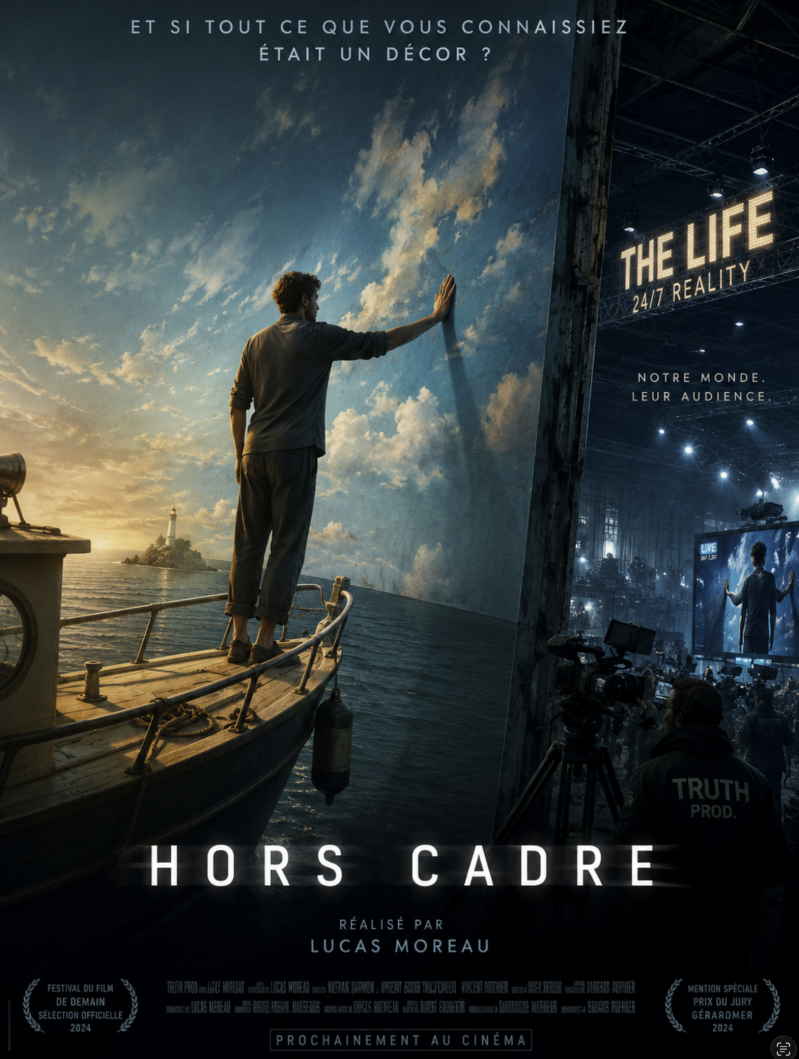
Situation : Vous présentez le document iconographique ci-dessus : l’affiche du film "Hors cadre" où on voit le personnage principal, John, debout sur un bateau, touchant un mur peint en forme de ciel. Le mur est un décor de studio immense, et l’image révèle que le monde dans lequel John a toujours vécu est en réalité une gigantesque émission de téléréalité filmée en secret.
Problématique suggérée : How does the film question the boundary between fiction and reality?
Points à aborder :
-
Description (personnage, décor, la révélation du ciel peint).
-
Signification : critique de la téléréalité, du voyeurisme, manipulation des médias.
-
Lien avec l’axe : frontière brouillée entre fiction et réalité, quête de vérité, liberté individuelle.
-
Opinion personnelle : à l’ère des réseaux sociaux, vivons-nous dans un « Hors cadre"» ?
Compréhension écrite
Article (adapté de The Atlantic, 2022)
Why We Still Read Orwell’s 1984
Seventy years after its publication, George Orwell’s 1984 remains one of the most influential novels of all time. The story of Winston Smith, a man who tries to rebel against the totalitarian regime of Big Brother, has sold over 30 million copies. Every time a government increases surveillance or limits free speech, sales of the book spike.
Orwell did not just predict the future; he created a language to describe it. Terms like “Big Brother”, “doublethink” (holding two contradictory beliefs at once) and “thoughtcrime” have entered everyday vocabulary. The novel also introduced the idea of “Newspeak”, a simplified language designed to make dissent impossible. “The purpose of Newspeak was not only to provide a medium of expression for the world-view of IngSoc, but to make all other modes of thought impossible,” Orwell wrote.
Some critics argue that 1984 has become a cliché, used by politicians of all sides to attack their opponents. Yet its power endures because it taps into a universal fear: the fear of losing control over our own minds. In an age of algorithms and misinformation, Orwell’s warning feels more urgent than ever.
Questions :
-
What happens to sales of 1984 when governments restrict freedoms?
-
Explain “doublethink” in your own words.
-
According to Orwell, what was the purpose of Newspeak?
-
Why do some critics say 1984 has become a cliché?
-
Why does the article say Orwell’s warning is still urgent today?
Compréhension orale
Podcast sur le roman dystopique
Script :
Voix : Welcome to “Between the Lines”. Today, we’re talking about dystopian fiction with our guest, Professor Emma Clarke. Professor Clarke, why are young readers so drawn to dystopian stories like The Hunger Games or Divergent?
Prof. Clarke : “That’s a fascinating question. On the surface, dystopias are thrilling adventures – they’ve got danger, rebellion, strong young heroes. But more deeply, they speak to the anxieties teenagers feel. Growing up, you realise the adult world is flawed: there’s inequality, climate change, political corruption. Dystopian novels take those fears and amplify them. They say, ‘Look, this is what could happen if we don’t act.’ But they also offer hope: a single brave individual can resist. For many young people, that’s incredibly empowering.”
Voix : Do you think dystopian fiction can actually change people’s behaviour?
Prof. Clarke : “Indirectly, yes. Fiction doesn’t usually trigger a revolution, but it shapes our imagination. When activists protest against mass surveillance, they often reference 1984. When young people march for the climate, they sometimes carry signs inspired by The Hunger Games – like the three-finger salute. Fiction gives us symbols and stories to rally around. So, it changes culture, and culture eventually changes politics.”
Questions :
-
According to Professor Clarke, why do dystopian stories appeal to teenagers?
-
What positive message does dystopian fiction often contain?
-
What example does she give of fiction inspiring real-world activism?
-
According to her, how does fiction influence politics?
Contrôle continu
A. Compréhension écrite (10 points)
Lisez le texte suivant (adapté d’un article sur l’impact de la science-fiction) :
“Science fiction is often dismissed as mere entertainment, but it has a long history of shaping real-world technology. The communicators in Star Trek inspired the first mobile phones. The concept of virtual reality was explored in novels like Neuromancer long before it became accessible to the public. More importantly, sci-fi asks ethical questions: what happens if robots become conscious? What if we can clone humans? These are no longer abstract questions. Scientists and politicians regularly consult science fiction authors because they have spent decades thinking about futures we are now entering. As writer Isaac Asimov once said, ‘Science fiction is the only literature that ever warned us about the future.’”
Questions :
-
Give two examples of real-world technologies inspired by science fiction. (2 pts)
-
What kind of ethical questions does sci-fi explore? (2 pts)
-
Why do scientists consult science fiction authors? (2 pts)
-
True or false? The author believes science fiction is just entertainment. Justify with a quotation. (2 pts)
-
Explain Asimov’s quote in your own words. (2 pts)
B. Compréhension orale (10 points)
Script :
“When I was a kid, I used to dream about living in a fantasy world like Harry Potter. I was shy at school, so I escaped into books. At first, my parents were worried – they said I spent too much time in imaginary worlds. But then I started writing my own stories, and it changed my life. I wrote about a girl who discovers she has magical powers and uses them to stand up to bullies. That story was my way of processing my own fear. Now I’m a published author, and I get letters from readers saying my books helped them through difficult times. So, I think fiction is not an escape from reality – it’s a way of coping with it, and sometimes transforming it.”
Questions :
-
What did the speaker dream about as a child? (2 pts)
-
Why were her parents worried? (2 pts)
-
What was her own story about? (2 pts)
-
How does she describe the relationship between fiction and reality? (2 pts)
-
What impact do her books have on readers? (2 pts)
C. Expression écrite (10 points)
Traitez au choix l’un des deux sujets (80-100 mots) :
-
Sujet 1 : Do you think it is dangerous to confuse fiction and reality? Justify with examples.
-
Sujet 2 : Write a short paragraph imagining the world in 50 years if one current problem continues. Use elements of dystopian fiction.
D. Expression orale (10 points)
À préparer en 10 minutes, à présenter en 5 minutes.
Vous présentez la citation suivante de Neil Gaiman : “Fairy tales are more than true: not because they tell us that dragons exist, but because they tell us that dragons can be beaten.”
Expliquez ce que cette citation signifie pour vous, donnez des exemples de contes ou de fictions qui inspirent le courage, et reliez-la à l’axe « Fictions et réalités ».