méthode, vocabulaire, exemples | Bac
L’axe « Art et pouvoir » explore les liens étroits et complexes entre la création artistique et les formes d’autorité, qu’elles soient politiques, économiques ou sociales. L’art peut servir le pouvoir – en célébrant un régime, en diffusant une propagande ou en renforçant un ordre établi – mais il peut aussi le contester, le critiquer et devenir un instrument de résistance. Dans le monde anglophone, des fresques de Banksy aux chansons de Bob Dylan, des pièces de Shakespeare aux discours d’investiture présidentielle, la culture est un champ de bataille où se jouent la liberté d’expression, la mémoire collective et la transformation sociale. Cet axe invite les élèves à analyser comment les artistes, écrivains, cinéastes et musiciens façonnent et interrogent le pouvoir, et comment le pouvoir, en retour, cherche à contrôler ou à instrumentaliser l’art. Cette page donne la problématique,le vocabulaire indispensable et des exemples pour réussir aussi bien l’expression écrite que l’oral.

🎨 Vocabulaire thématique : Art et pouvoir
Ce vocabulaire est indispensable pour analyser des œuvres d’art, des affiches, des chansons engagées, des romans ou tout document traitant des relations entre l’art, la société et le pouvoir.
| Anglais | Français |
|---|---|
| art | art |
| artwork | œuvre d’art |
| painting | peinture |
| sculpture | sculpture |
| street art | art de rue |
| graffiti | graffiti |
| mural | fresque murale |
| performance | spectacle, performance |
| exhibition | exposition |
| gallery | galerie |
| masterpiece | chef-d’œuvre |
| propaganda | propagande |
| censorship | censure |
| freedom of expression | liberté d’expression |
| political activism | activisme politique |
| to denounce | dénoncer |
| to raise awareness | sensibiliser |
| to empower | donner du pouvoir, autonomiser |
| to inspire | inspirer |
| to provoke | provoquer |
| to question | remettre en question |
| to convey a message | transmettre un message |
| symbol | symbole |
| controversy | controverse |
| mainstream | dominant, grand public |
| counterculture | contre-culture |
| resistance | résistance |
| protest song | chanson contestataire |
| dystopia | dystopie |
| utopia | utopie |
| social change | changement social |
📚 Grammaire – La voix passive pour décrire l’impact de l’art
La voix passive est particulièrement utile pour parler de l’art, car elle permet de mettre l’accent sur l’œuvre ou le message plutôt que sur l’artiste. Elle est aussi employée lorsque l’agent (celui qui réalise l’action) est inconnu, évident ou non pertinent.
Formation : be (conjugué au temps voulu) + participe passé du verbe.
| Temps | Voix active | Voix passive |
|---|---|---|
| Present simple | They paint murals. | Murals are painted. |
| Past simple | Banksy created this piece. | This piece was created by Banksy. |
| Present perfect | The government has banned the song. | The song has been banned (by the government). |
| Future (will) | They will exhibit the painting. | The painting will be exhibited. |
| Modal | You can see the sculpture. | The sculpture can be seen. |
🎨 Emplois dans le thème
Voici quelques exemples de la voix passive appliquée au thème « Art et pouvoir » :
- The mural was commissioned by the city council.
(La fresque a été commandée par le conseil municipal.) - His work has been criticised for being too political.
(Son œuvre a été critiquée parce qu’elle est jugée trop politique.) - Graffiti is often considered vandalism.
(Le graffiti est souvent considéré comme du vandalisme.)
L’art face au pouvoir dans les sociétés anglophones
Dans l’histoire du monde anglophone, l’art et le pouvoir entretiennent une relation ambivalente. D’un côté, les souverains britanniques ont utilisé le portrait officiel pour asseoir leur légitimité. De la Renaissance à l’époque victorienne, la peinture glorifiait la monarchie, les conquêtes militaires et la puissance impériale. Les monuments, comme la statue de l’amiral Nelson à Trafalgar Square, célèbrent les héros nationaux et rappellent la force de l’Empire.
Au XXᵉ siècle, l’art est devenu un outil de contestation. Pendant les deux guerres mondiales, les affiches de recrutement – tel le fameux « Lord Kitchener Wants You » – sont des exemples de propagande d’État. Mais les mêmes périodes ont vu naître des œuvres pacifistes, comme les poèmes de Wilfred Owen, qui dénoncent l’horreur des tranchées. Aux États-Unis, la lutte pour les droits civiques s’est accompagnée d’une explosion artistique : le gospel, le blues, puis la soul et le hip-hop ont porté la voix des opprimés. Des chansons comme « Strange Fruit » de Billie Holiday ou « The Times They Are a-Changin’ » de Bob Dylan sont devenues des hymnes de résistance.
Le street art, et notamment l’œuvre de Banksy, illustre la capacité de l’art à s’emparer de l’espace public pour dénoncer les injustices. Ses pochoirs, réalisés illégalement sur les murs de Londres, de New York ou de Bethléem, critiquent la guerre, le consumérisme, la surveillance ou les inégalités. Le pouvoir réagit de manière paradoxale : tantôt il efface ces œuvres en les qualifiant de vandalisme, tantôt il les protège et les vend aux enchères, montrant comment l’art contestataire peut être absorbé par le marché.
La littérature a également été un terrain de résistance. *1984* de George Orwell, Le Meilleur des mondes d’Aldous Huxley ou La Servante écarlate de Margaret Atwood sont des dystopies qui mettent en garde contre les dérives totalitaires. Ces romans, souvent étudiés dans les écoles, participent à la formation d’une conscience critique.
Aujourd’hui, les réseaux sociaux offrent une plateforme planétaire à l’art engagé. Une caricature, une chanson ou une vidéo peuvent devenir virales et influencer l’opinion publique en quelques heures. Cependant, le pouvoir économique et politique tente aussi de contrôler ces canaux, par la censure ou la manipulation algorithmique.
Ainsi, l’art n’est jamais neutre : il reflète, construit ou conteste le pouvoir, et c’est dans cette tension qu’il trouve sa force.
Le street art, voix des sans-voix ?
Le street art est né aux États-Unis dans les années 1970, avec les tags et les graffitis dans le métro new-yorkais. Mais c’est au Royaume-Uni, avec l’émergence de Banksy dans les années 2000, que le street art a acquis une reconnaissance mondiale.
Banksy, dont l’identité reste mystérieuse, réalise des pochoirs dans l’espace public pour critiquer la société de consommation, les inégalités, la guerre, le racisme ou la crise migratoire. Ses œuvres, souvent satiriques, transforment un mur banal en tribune politique. Par exemple, Girl with Balloon est devenue une image iconique d’espoir et de fragilité. Napalm, qui détourne une photo de la guerre du Vietnam, dénonce l’impérialisme américain.
Le pouvoir réagit de manière contradictoire. Les autorités municipales effacent régulièrement ses œuvres en les qualifiant de dégradations. Pourtant, certaines d’entre elles sont protégées par des vitres et attirent des touristes du monde entier. En 2018, son tableau Girl with Balloon s’est partiellement auto-détruit juste après avoir été vendu aux enchères, créant une nouvelle œuvre intitulée Love is in the Bin. Ce geste spectaculaire interroge la valeur marchande de l’art et la récupération par le pouvoir économique.
D’autres artistes, comme Shepard Fairey aux États-Unis (célèbre pour l’affiche « Hope » de Barack Obama) ou des collectifs féministes, utilisent la rue pour contourner les circuits traditionnels. Le street art démocratise l’art, mais sa légalité et sa pérennité restent fragiles.
Exercices
grammaire : voix passive
-
Mettez à la voix passive : The artist painted the portrait in 1945. → The portrait was painted in 1945 (by the artist).
-
Transformez : They have banned the film in several countries. → The film has been banned in several countries.
-
Traduisez en utilisant le passif : « Cette fresque a été réalisée par un artiste anonyme. » → This mural was created by an anonymous artist.
Expression écrite
Sujet : You have read the article “When Art Becomes Protest”. Write a short essay (150-180 words) in which you :
-
Explain why art is an effective tool for protest.
-
Discuss whether art should ever be censored by authorities.
-
Give your personal opinion.
Consignes : structurez votre essai (introduction, développement, conclusion). Utilisez au moins trois connecteurs logiques et deux expressions du vocabulaire thématique.
Expression orale
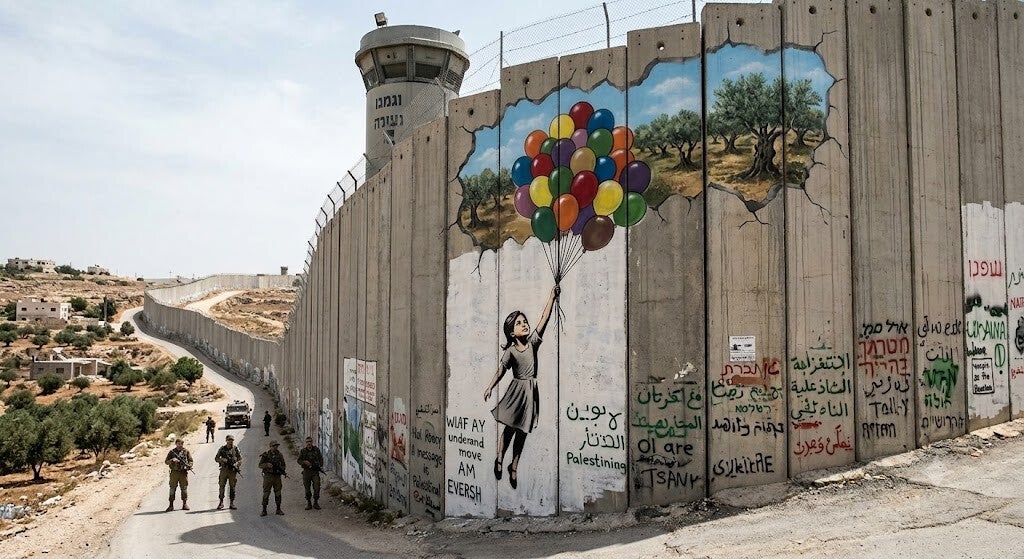
Situation : Vous présentez le document iconographique ci-dessus : une photographie du mur de séparation en Cisjordanie, sur lequel Banksy a peint une fillette s’élevant dans les airs en tenant une grappe de ballons. Des soldats sont visibles au loin.
Problématique suggérée : How can street art challenge political power?
Points à aborder :
-
Description (contexte, éléments visuels, contraste entre l’enfant et le mur).
-
Signification : l’art comme échappatoire, critique de l’occupation, espoir.
-
Lien avec l’axe : art et résistance, occupation de l’espace public, portée universelle de l’image.
-
Opinion personnelle : l’art de rue est-il une forme légitime de protestation politique ?
Compréhension écrite
When Art Becomes Protest: The Power of the Poster ((adapté de The Guardian, 2021)
From the Vietnam War to the Black Lives Matter movement, posters have played a crucial role in political struggle. Cheap, easy to produce and impossible to ignore, a well-designed poster can communicate a message in seconds. During the 1960s, anti-war activists in the United States used bold graphics and short slogans – such as “Make Love, Not War” – to reach a mass audience. The famous photograph of a girl fleeing a napalm attack, transformed into a protest poster, shocked the world and changed public opinion.
More recently, the “We the People” poster series, created during the 2017 Women’s March, celebrated diversity and resistance. Artist Shepard Fairey, known for the Obama “Hope” poster, argues that “art is not a passive reflection of society; it is an active force that can inspire change.” Yet, governments have long understood the subversive potential of posters and often try to suppress them. In some authoritarian regimes, political posters are torn down, and the artists risk imprisonment.
In democratic countries, the tension remains. Should street posters be considered free speech or visual pollution? For many campaigners, the answer is clear: as long as power exists, protest posters will follow.
Questions :
-
According to the text, why have posters been an important tool in political struggles?
-
Give one historical example and one contemporary example of protest posters mentioned.
-
What does Shepard Fairey mean by “art is not a passive reflection of society”?
-
How do some governments react to political posters?
-
In the final sentence, what does “as long as power exists, protest posters will follow” suggest about the relationship between art and power?
Compréhension orale
Interview radio
Script
Voix : You’re listening to Arts Now. Today I’m joined by Lena, a young spoken word poet from Chicago. Lena, your poetry often tackles issues like racism and police brutality. Why did you choose words rather than images or music?
Lena : “For me, words are weapons. When I’m on stage, I can look people in the eye and challenge them directly. Poetry is an ancient form of resistance – you can trace it back to enslaved Africans who used songs and stories to survive. But it’s also incredibly modern. A three-minute poem can go viral and reach more people than a painting in a museum.”
Journaliste : Do you think art can really change politics, or is it just preaching to the converted?
Lena : “That’s the big question, isn’t it? I think art plants seeds. It might not change a law overnight, but it changes hearts. And changed hearts lead to changed votes. Every major social movement, from civil rights to LGBTQ+ rights, had artists at the forefront. We create the soundtrack, the visuals, the slogans. Without art, movements would be silent.”
Journaliste : Have you ever been censored or silenced for your poetry?
Lena : “Not directly, but I’ve been told to ‘tone it down’ at school events. That only made me louder.”
Questions :
-
Why does Lena call words “weapons”?
-
According to Lena, how does art contribute to social movements?
-
Does Lena believe art can change politics directly? Explain her point of view.
-
What example of historical resistance does she give?
-
What happened to her at school events, and how did she react?
Contrôle continu
Compréhension écrite (10 points)
Lisez le texte suivant (extrait d’un discours de l’écrivain américain John Steinbeck, 1962, lors de la remise du prix Nobel) :
“Literature was not promulgated by a pale and emasculated critical priesthood singing their litanies in empty churches, nor is it a game for the cloistered elect, the tinhorn mendicants of low-calorie despair. Literature is as old as speech. It grew out of human need for it, and it has not changed except to become more needed. The ancient commission of the writer has not changed. He is charged with exposing our many grievous faults and failures, with dredging up to the light our dark and dangerous dreams for the purpose of improvement.”
Questions :
-
According to Steinbeck, what is the mission of the writer? (2 pts)
-
What does he reject about the way literature is sometimes perceived? (2 pts)
-
True or false? Steinbeck thinks literature has become less necessary over time. Justify with a quotation. (3 pts)
-
Explain the phrase “dredging up to the light our dark and dangerous dreams” in your own words. (3 pts)
B. Compréhension orale (10 points)
Script :
“My father was a factory worker, but every Saturday he would take me to the public library. He said, ‘Son, these books are more powerful than any politician. They can’t be silenced. Read everything, even what you disagree with. That’s how you stay free.’ I didn’t understand at the time, but now I do. When a government bans a book, it’s afraid of ideas. And when a people stop reading, they hand over their power without a fight.”
Questions :
-
What habit did the speaker’s father have every Saturday? (2 pts)
-
What did the father say about books compared to politicians? (2 pts)
-
According to the speaker, why does a government ban a book? (3 pts)
-
What warning does the speaker give in the last sentence? (3 pts)
C. Expression écrite (10 points)
Traitez au choix l’un des deux sujets (80-100 mots) :
-
Sujet 1 : In your opinion, can a song or a painting really change the world? Justify with examples.
-
Sujet 2 : Write a short paragraph about an artist (real or fictional) who uses their art to fight against injustice.
D. Expression orale (10 points)
À préparer en 10 minutes, à présenter en 5 minutes.
Vous présentez la citation suivante d’Oscar Wilde : “It is through art, and through art only, that we can realise our perfection; through art, and through art only, that we can shield ourselves from the sordid perils of actual existence.”
Expliquez ce que cette citation signifie pour vous, illustrez avec des exemples et reliez-la à l’axe « Art et pouvoir ».