Les connecteurs logiques sont indispensables pour construire un raisonnement clair et cohérent en anglais. Ils permettent d'enchaîner les idées, d'exprimer une opposition, une cause, une conséquence ou une conclusion avec précision. Cette fiche de synthèse rassemble les principaux linking words, des exemples d'utilisation et des exercices avancés pour consolider tes acquis et réussir les évaluations du contrôle continu
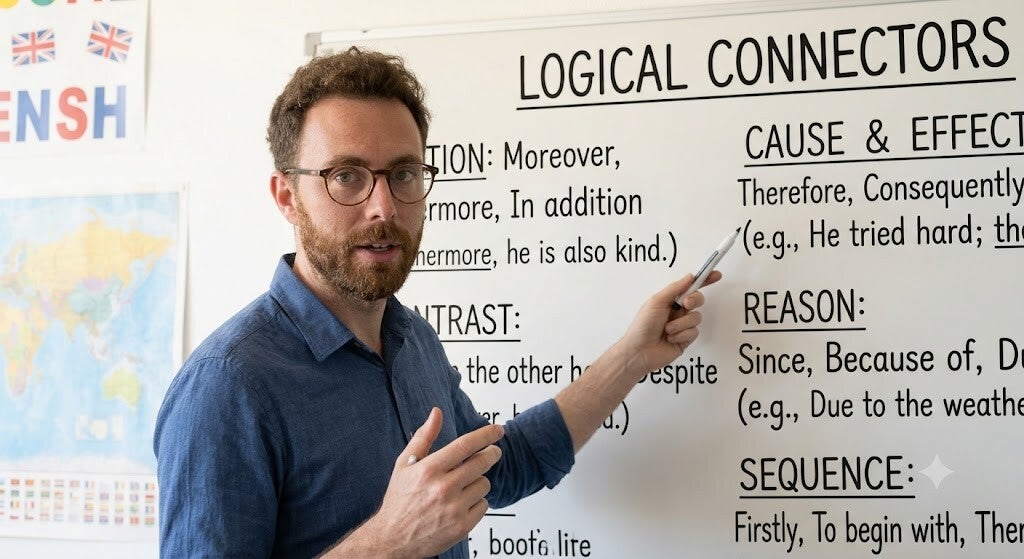
Tableau synthétique des connecteurs par fonction
Les connecteurs logiques permettent d’organiser une expression écrite, de relier les idées et de construire une argumentation claire. Leur choix dépend du registre de langue et de la fonction exprimée.
1. Addition
| Connecteur | Registre | Exemple |
|---|---|---|
| and | neutre | I like tea and coffee. |
| also | neutre | She sings; she also dances. |
| too | neutre (fin de phrase) | I like it too. |
| as well | neutre (fin de phrase) | She plays the guitar as well. |
| as well as | neutre | She speaks French as well as English. |
| in addition | soutenu | In addition, the plan is costly. |
| moreover | soutenu | Moreover, it’s bad for your health. |
| furthermore | soutenu | Furthermore, the data confirms this. |
| besides | informel | I don’t want to go; besides, it’s late. |
| not only… but also | soutenu | Not only is it cheap, but it’s also durable. |
| on top of that | informel | He’s rude, and on top of that, lazy. |
2. Cause / Raison
| Connecteur | Structure | Exemple |
|---|---|---|
| because | + sujet + verbe | I stayed because I was tired. |
| since | + sujet + verbe | Since you’re here, let’s start. |
| as | + sujet + verbe | As it was late, we left. |
| because of | + nom / V-ing | Because of the rain, we stayed in. |
| due to | + nom | The delay was due to a strike. |
| thanks to | + nom | Thanks to her help, I passed. |
3. Conséquence / Résultat
| Connecteur | Registre | Exemple |
|---|---|---|
| so | neutre | I was tired, so I went to bed. |
| therefore | soutenu | He studied hard. Therefore, he passed. |
| as a result | soutenu | As a result, sales increased. |
| consequently | très soutenu | Consequently, the law was changed. |
4. Opposition / Contraste
| Connecteur | Structure / Usage | Exemple |
|---|---|---|
| but | Relie deux propositions | He’s rich but unhappy. |
| yet | Comme but, légèrement plus soutenu | It’s simple, yet effective. |
| however | Début ou milieu de phrase | It was cold. However, we went out. |
| nevertheless | Formel | It was risky. Nevertheless, they tried. |
| nonetheless | Formel | She was tired; nonetheless, she finished. |
| while / whereas | + sujet + verbe | He likes tea, while she prefers coffee. |
| unlike | + nom | Unlike her brother, she is shy. |
| contrary to | + nom | Contrary to popular belief, bats aren’t blind. |
| in contrast | Début de phrase | In contrast, the south is sunny. |
| on the one hand… on the other hand | Présente deux aspects opposés | On the one hand, it’s cheap. On the other hand, it’s fragile. |
5. Concession
Les connecteurs de concession permettent d’introduire une idée contraire ou une limite à l’argument présenté.
| Connecteur | Structure | Exemple |
|---|---|---|
| although | + sujet + verbe | Although it rained, we went out. |
| even though | + sujet + verbe (insistance) | Even though she was sick, she worked. |
| though | + sujet + verbe | It’s hard. I like it, though. |
| despite | + nom / V-ing | Despite the rain, we walked. |
| in spite of | + nom / V-ing | In spite of being ill, he attended. |
| despite the fact that | + sujet + verbe | Despite the fact that it’s late, I’ll call. |
| admittedly… but | Concession suivie d’une opposition | Admittedly, it's expensive, but it's worth it. |
6. But / Objectif
| Connecteur | Structure | Exemple |
|---|---|---|
| to | + base verbale | I study to pass my exams. |
| in order to | + base verbale | She left early in order to arrive on time. |
| so as to | + base verbale | He whispered so as not to wake the baby. |
| so that | + sujet + modal | Speak louder so that everyone can hear. |
| for | + nom / V-ing | This tool is for cutting metal. |
7. Illustration / Exemple
Les connecteurs d’illustration permettent d’introduire un exemple concret pour appuyer une idée ou un argument.
| Connecteur | Structure / Usage | Exemple |
|---|---|---|
| for example | Introduit un exemple | Many countries, for example Japan, have aged populations. |
| for instance | Synonyme de for example | Some animals, for instance bats, are nocturnal. |
| such as | + nom / V-ing | Fruits such as apples and oranges are healthy. |
| like | + nom (plus informel) | Sports like tennis and swimming are popular. |
| namely | Précise une liste exhaustive | Two colours, namely red and blue, were chosen. |
| e.g. | Abréviation formelle de for example | Citrus fruits (e.g., lemons, oranges) are acidic. |
| i.e. | Signifie « c’est-à-dire » | He’s a polyglot, i.e., he speaks several languages. |
| a case in point | Exemple particulièrement représentatif | A case in point is the city of Copenhagen. |
8. Ordre / Énumération
Ces connecteurs permettent d’organiser une argumentation en plusieurs étapes. Ils sont particulièrement utiles dans une expression écrite structurée.
| Connecteur | Usage |
|---|---|
| first / firstly | Premier point d’une énumération |
| first of all | Pour commencer, avec insistance |
| to begin with | Introduit le premier argument |
| second / secondly | Deuxième étape ou argument |
| third / thirdly | Troisième point |
| next | Point suivant |
| then | Organisation chronologique ou logique |
| finally / lastly | Dernier point d’une liste |
| last but not least | Dernier élément mais pas le moins important |
| to conclude | Annonce une conclusion |
9. Conclusion / Résumé
Ces expressions permettent de terminer une argumentation, de résumer les idées principales ou de donner une vision globale.
| Connecteur | Exemple |
|---|---|
| in conclusion | In conclusion, more research is needed. |
| to sum up | To sum up, it was a success. |
| in short | In short, we need to act now. |
| to put it in a nutshell | To put it in a nutshell, it’s complicated. |
| all in all | All in all, it was a good trip. |
| on the whole | On the whole, I agree. |
| ultimately | Ultimately, the choice is yours. |
À retenir
- Privilégiez les connecteurs neutres et soutenus : moreover, however, therefore, nevertheless, in conclusion.
- Un paragraphe argumentatif efficace suit souvent le schéma : First → Moreover → For instance → However → Therefore.
- Les connecteurs doivent servir la logique du raisonnement et non être ajoutés artificiellement.
- Évitez de répéter toujours les mêmes mots comme and, but, so : variez avec moreover, however, therefore, as a result.
- Respectez la structure grammaticale : par exemple because of + nom / V-ing.
- Un bon paragraphe argumentatif combine généralement : addition → exemple → opposition → conséquence → conclusion.
Nuances entre connecteurs proches
Certains connecteurs ont un sens proche mais ne s’emploient pas de la même manière. La différence porte souvent sur leur structure grammaticale et leur registre de langue.
1. However vs Although vs Despite
Ces trois expressions permettent d’exprimer une opposition ou une concession, mais elles n’ont pas la même construction.
| Connecteur | Structure | Exemple |
|---|---|---|
| However |
Adverbe. En début ou milieu de phrase, suivi d’une virgule. |
It was hard. However, she succeeded. |
| Although | Conjonction + sujet + verbe | Although it was hard, she succeeded. |
| Despite | Préposition + nom / V-ing | Despite the difficulty, she succeeded. |
Erreurs fréquentes
-
❌
Although the difficulty, she succeeded.
✅ Although it was difficult, she succeeded. -
❌
Despite it was hard, she succeeded.
✅ Despite the difficulty, she succeeded. -
❌
However it was hard, she succeeded.
✅ However, it was hard, but she succeeded.
2. Because vs Because of vs Due to
Ces trois expressions introduisent une cause, mais leur construction est différente.
| Connecteur | Structure | Exemple |
|---|---|---|
| Because | Conjonction + sujet + verbe | I stayed home because I was ill. |
| Because of | Préposition + nom / V-ing | I stayed home because of my illness. |
| Due to |
Adjectif + nom. Souvent après le verbe be. |
The delay was due to a strike. |
Erreurs fréquentes
-
❌
Because of I was ill...
✅ Because I was ill...
ou
✅ Because of my illness... -
❌
The delay was because a strike.
✅ The delay was due to a strike.
3. So vs Therefore vs Thus
Ces trois connecteurs expriment une conséquence, mais leur niveau de langue varie.
| Connecteur | Usage | Exemple |
|---|---|---|
| So |
Le plus courant. Utilisé à l’oral et à l’écrit. |
It rained, so we stayed in. |
| Therefore |
Plus formel. Souvent placé en début de phrase. |
The budget was cut. Therefore, we had to adapt. |
| Thus |
Très formel. Souvent utilisé dans les textes académiques. |
They raised prices, thus reducing demand. |
À retenir pour le bac
- However = opposition entre deux idées indépendantes.
- Although = concession + proposition complète.
- Despite = concession + nom ou V-ing.
- Because introduit une cause avec un verbe ; because of / due to introduisent un groupe nominal.
- So convient dans tous les contextes courants ; therefore et thus sont préférables dans une argumentation formelle.
Registres de langue et choix des connecteurs
Le choix des connecteurs dépend du registre de langue et du type de production écrite. Dans une copie du bac, il faut privilégier des connecteurs neutres ou soutenus afin de construire une argumentation claire et structurée.
1. Les différents registres de connecteurs
| Registre | Connecteurs appropriés | Contextes d’utilisation |
|---|---|---|
| Formel | furthermore, moreover, consequently, nevertheless, therefore, in addition, however, indeed, thus, hence | Essais argumentatifs, lettres officielles, rapports, textes académiques. |
| Neutre | because, so, but, also, for example, such as, although, while, as a result, first, finally | Expression écrite du bac, argumentation générale, textes explicatifs. |
| Informel | besides, anyway, so, like, and, but, on top of that | Dialogue, conversation, courriel amical, expression orale spontanée. |
2. Connecteurs recommandés pour le bac
Dans une production écrite argumentative, il est préférable d’utiliser des connecteurs qui montrent une organisation logique du raisonnement.
| Fonction | Connecteurs conseillés | Exemple |
|---|---|---|
| Ajouter une idée | Moreover, Furthermore, In addition, Also | Moreover, technology can improve access to education. |
| Exprimer une opposition | However, Nevertheless, Although, While | However, this solution also has some drawbacks. |
| Exprimer une conséquence | Therefore, Consequently, As a result, So | As a result, many people changed their habits. |
| Donner un exemple | For example, For instance, Such as | For instance, renewable energy reduces pollution. |
| Conclure | Finally, In conclusion, To sum up | In conclusion, governments must take action. |
3. Connecteurs à éviter dans une dissertation argumentative
| Connecteur | Pourquoi l’éviter | Alternative |
|---|---|---|
| besides | Trop conversationnel | Moreover / Furthermore |
| anyway | Très oral, utilisé pour changer de sujet | However / Nevertheless |
| like | Informel pour introduire un exemple | Such as / For example |
| on top of that | Trop relâché | In addition / Furthermore |
À retenir pour l’expression écrite du bac
- Privilégiez le registre neutre ou soutenu.
- Variez vos connecteurs pour éviter la répétition de and, but, so.
- Utilisez des connecteurs adaptés à la fonction : Moreover pour ajouter, However pour nuancer, Therefore pour conclure une conséquence.
- Évitez les marqueurs trop oraux dans une dissertation : besides, anyway, like (au sens de « par exemple »).
- Un bon paragraphe argumentatif doit montrer une progression logique : First → Moreover → For example → However → Therefore.
Pièges et confusions fréquents avec les connecteurs
Les connecteurs permettent d’organiser un raisonnement, mais certains sont souvent mal employés car leur sens ou leur construction grammaticale diffèrent.
Erreurs fréquentes et corrections
| Erreur | Correction |
|---|---|
|
Actually, I live in Paris.
(pour dire « actuellement ») |
Currently / At present, I live in Paris.
Actually signifie « en réalité », « en fait ». Actually, I don't agree with this idea. |
| ❌ Despite it rained |
✅ Despite the rain
ou ✅ Although it rained Despite est une préposition : despite + nom / V-ing |
| ❌ Because of I was tired |
✅ Because I was tired
ou ✅ Because of my tiredness Because + sujet + verbe Because of + nom / V-ing |
| ❌ Although the rain, we went out. |
✅ Despite the rain, we went out.
ou ✅ Although it was raining, we went out. Although introduit une proposition complète : although + sujet + verbe |
| He is tired, although he keeps working. |
Cette phrase est correcte.
Although exprime une concession : une idée est vraie, mais elle n’empêche pas le résultat. Ne pas le confondre avec but, qui exprime simplement une opposition. He is tired, but he keeps working. → Il est fatigué mais il continue à travailler. |
|
❌ On the other side
(pour « d’un autre côté ») |
✅ On the other hand
On the other hand introduit un autre point de vue ou un argument opposé. On the one hand, technology is useful. On the other hand, it can create problems. |
| ❌ According to me |
✅ In my opinion
ou ✅ To my mind According to signifie « selon une source extérieure ». According to scientists, climate change is accelerating. |
À retenir
- Actually = « en réalité », jamais « actuellement ».
- Although + proposition complète (sujet + verbe).
- Despite / In spite of + nom ou V-ing.
- Because explique une cause avec une proposition ; because of s’utilise avec un nom.
- On the other hand est le connecteur correct pour introduire un autre point de vue.
- According to nécessite une source ; pour donner son opinion, utiliser In my opinion ou To my mind.
Exercices
Exercice 1
Complétez avec un connecteur approprié. Parfois plusieurs réponses sont possibles.
- __________ it was late, they decided to continue the discussion. (concession)
- The flight was cancelled __________ the storm. (cause)
- The company lost money; __________, it had to lay off workers. (conséquence)
- He enjoys sports, __________ football, basketball and tennis. (exemple)
- __________ her excellent qualifications, she didn't get the job. (concession)
- She studied hard; __________, she passed the exam with flying colours. (conséquence)
Exercice 2
Corrigez les erreurs dans les phrases suivantes.
- Actually, I am studying English at university. (je veux dire « actuellement »)
- Despite it was raining, we went for a walk.
- Because of he was sick, he stayed home.
- On the other side, technology can isolate people.
- According to me, this is the best solution.
Exercice 3
Reliez les deux phrases en utilisant le connecteur indiqué.
- It was very cold. They went swimming. (although)
- The traffic was terrible. I arrived late. (because of)
- She works hard. She wants to get a promotion. (in order to)
- Many animals are endangered. Pandas and tigers are examples. (such as)
- The film was long. It was never boring. (however)
Exercice 4
Traduisez en anglais en utilisant le connecteur indiqué.
-
Bien qu'il soit fatigué, il a fini son travail. (although)
-
Grâce à son aide, j'ai réussi. (thanks to)
-
Je suis arrivé en retard à cause des embouteillages. (because of)
-
Elle a économisé de l'argent afin de voyager. (in order to)
-
Le problème est complexe ; par conséquent, il faudra du temps pour le résoudre. (therefore)
Exercice de synthèse
A. Complétez le paragraphe avec des connecteurs variés.
Social media have transformed the way we communicate. (1) __________, they allow us to stay in touch with friends all over the world. (2) __________, they have created new problems, (3) __________ cyberbullying and addiction. (4) __________ these dangers, many people think the benefits outweigh the drawbacks. (5) __________, it is essential to use social media responsibly.
B. Chaque phrase contient une erreur. Corrigez-la.
- He didn’t study; consequently of that, he failed.
- Although the high cost, they bought the house.
- She speaks not only English but also she speaks Spanish.
- I left early so that avoid the traffic.
- He is a great athlete. Moreover, he is a brilliant student. (pas d'erreur ici : identifiez si elle est correcte)
C. Rédigez un court paragraphe argumentatif (5-6 phrases) sur le thème « Les avantages et inconvénients du télétravail ». Utilisez au moins cinq connecteurs variés (addition, opposition, concession, conséquence, conclusion).
Quelques ouvrages pour progresser