Compréhension écrite : exemple de devoir proposé lors du contrôle continu sur le thème "Identités et échanges"
Document support :
Living Between Two Worlds
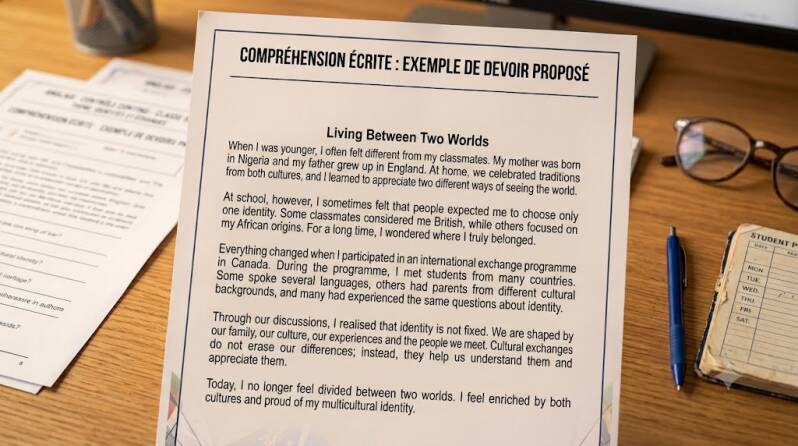
When I was younger, I often felt different from my classmates. My mother was born in Nigeria and my father grew up in England. At home, we celebrated traditions from both cultures, and I learned to appreciate two different ways of seeing the world.
At school, however, I sometimes felt that people expected me to choose only one identity. Some classmates considered me British, while others focused on my African origins. For a long time, I wondered where I truly belonged.
Everything changed when I participated in an international exchange programme in Canada. During the programme, I met students from many countries. Some spoke several languages, others had parents from different cultural backgrounds, and many had experienced the same questions about identity.
Through our discussions, I realised that identity is not fixed. We are shaped by our family, our culture, our experiences and the people we meet. Cultural exchanges do not erase our differences; instead, they help us understand them and appreciate them.
Today, I no longer feel divided between two worlds. I feel enriched by both cultures and proud of my multicultural identity.
Adapted from a fictional testimony.
📚 Vocabulaire essentiel : Identities and Exchanges
| Anglais | Français |
|---|---|
| identity | identité |
| exchange | échange |
| migration | migration |
| immigration | immigration |
| emigration | émigration |
| refugee | réfugié |
| asylum seeker | demandeur d'asile |
| border | frontière |
| citizenship | citoyenneté |
| globalization | mondialisation |
| cultural diversity | diversité culturelle |
| multiculturalism | multiculturalisme |
| integration | intégration |
| inclusion | inclusion |
| discrimination | discrimination |
| tolerance | tolérance |
| community | communauté |
| heritage | patrimoine |
| tradition | tradition |
| belonging | sentiment d'appartenance |
Questions sur le document
A – General comprehension (6 points)
1. Choose the correct answer.
The document is mainly about:
a) studying abroad
b)cultural identity and exchanges
c)learning foreign languages
2. Who is the narrator?
Give two pieces of information about him/her.
3. Why did the narrator feel different when he/she was younger?
Answer in your own words.
B – Detailed comprehension (8 points)
4. Answer
- Mother’s origin ?
- Father’s origin ?
- Exchange programme location ?
- Main lesson learned ?
5. True or False? Justify with a quotation from the text.
a) The narrator always felt comfortable with his identity.
b) The exchange programme helped the narrator understand himself/herself better.
c) Cultural exchanges remove all differences between people.
6. What does the expression “Living Between Two Worlds” mean?
Explain in French or English.
C – Interpretation (6 points)
7. Explain the following sentence:
“Identity is not fixed.” (40–60 words)
8. According to the author, what role do cultural exchanges play in the construction of identity?
(50–80 words)
Réponses
Cliquez sur chaque item pour afficher les réponse

⚠️ À ne pas confondre
Ces mots se ressemblent mais ont des sens différents. Les maîtriser permet d'éviter des erreurs fréquentes en compréhension et en expression écrites.
| Anglais | Français | Différence |
|---|---|---|
| immigrant / emigrant | immigré / émigré | Un immigrant arrive dans un pays ; un emigrant quitte son pays. |
| refugee / migrant | réfugié / migrant | Le refugee fuit des persécutions ou une guerre ; le migrant change de pays pour diverses raisons. |
| country / countryside | pays / campagne | Country signifie « pays » ; countryside désigne la campagne. |
| customs / habits | coutumes / habitudes | Customs concerne les traditions d'un peuple ; habits désigne les habitudes personnelles. |
| cultural / traditional | culturel / traditionnel | Cultural est lié à la culture ; traditional à une tradition transmise. |
| nationality / citizenship | nationalité / citoyenneté | Nationality indique l'origine nationale ; citizenship renvoie au statut juridique et aux droits civiques. |
| border / frontier | frontière | Border est le terme le plus courant ; frontier est souvent employé dans un contexte historique, géographique ou symbolique. |